Wherio #2 — July 14th, 2026

Five real historical events. Guess where each one happened, then compare your score with the answers and locations below.

Play Wherio #2

Try all five events before revealing the answers.

Reveal answers and map
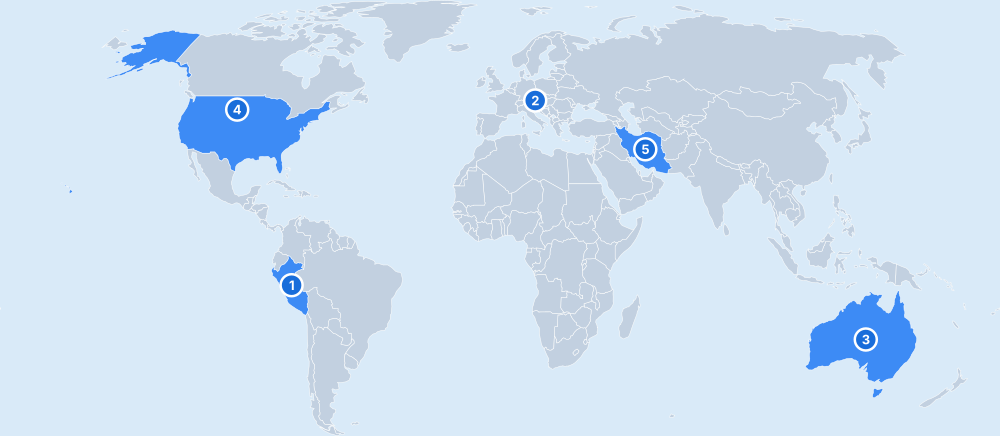
World map marking where the Wherio events of July 14th, 2026 happened
The answer locations for puzzle #2, numbered in round order.

1. Giant desert figures, visible only from the air, get their first serious study

Answer: 🇵🇪 Peru · 1940-41

The Nazca Lines, enormous geoglyphs etched into the desert of southern Peru, entered modern scholarship in the early twentieth century. Peruvian archaeologist Toribio Mejia Xesspe spotted them while hiking through the foothills in 1927, and American historian Paul Kosok, credited as the first scholar to study the lines in depth, flew over them during irrigation research and realized one formed a giant bird. German mathematician Maria Reiche then devoted her life to mapping and protecting them. The figures include a hummingbird 93 meters long and a condor spanning 134 meters, and their original purpose is still debated.

Geography clue given: It shares the world's highest navigable lake with a neighbor.

Learn more about this event →

2. A 640-year dynasty relinquishes power

Answer: 🇦🇹 Austria · 1918-11

Following the armistice that ended the First World War, Emperor Charles I of Austria, also King Charles IV of Hungary, renounced participation in state affairs. He was the last Habsburg monarch, closing out a dynasty that had dominated Central Europe for more than six centuries. Charles never formally abdicated, but the Republic of German-Austria was proclaimed the next day, and in April 1919 the National Assembly dethroned the Habsburgs and banished him for life. After two failed attempts to reclaim the Hungarian throne in 1921, he died in exile in 1922.

Geography clue given: The Danube flows through this landlocked, mountainous Alpine country.

Learn more about this event →

3. A dingo takes a baby, and a mother is wrongly convicted

Answer: 🇦🇺 Australia · August 17th, 1980

Nine-week-old Azaria Chamberlain was taken by a dingo from her family’s tent at Uluru, then widely known as Ayers Rock, in Australia’s Northern Territory. Her body was never found. Despite an initial inquest supporting the family, her mother Lindy Chamberlain was convicted of murder in 1982 and sentenced to life in prison, while father Michael received a suspended sentence. Lindy was released after Azaria’s jacket was found near a dingo den, and the convictions were overturned. In 2012, coroner Elizabeth Morris formally ruled that a dingo had taken the baby, closing one of Australia’s most notorious legal sagas.

Geography clue given: It is the world's flattest and driest inhabited continent.

Learn more about this event →

4. The world's prime meridian is chosen at a conference

Answer: 🇺🇸 United States of America · 1884-10

Delegates gathered in Washington, D.C. for the International Meridian Conference to settle a question of global coordination: where should the world’s prime meridian sit? The conference adopted the meridian passing through the Royal Observatory at Greenwich, England, as longitude zero. The decisive resolution passed 22 to 1, with San Domingo, now the Dominican Republic, voting against, and France and Brazil abstaining. The choice, made on American soil, laid the groundwork for a universal day and the worldwide system of standard time zones that followed.

Geography clue given: It is home to Yellowstone, widely considered the world's first national park.

Learn more about this event →

5. Astronomers, among them a famed poet, reform the calendar at an imperial observatory

Answer: 🇮🇷 Iran · 1079

The Seljuk Empire adopted the Jalali calendar, a solar calendar compiled on the orders of Sultan Malik-Shah I and his grand vizier Nizam al-Mulk. A committee of astronomers that included the poet and mathematician Omar Khayyam built it at the imperial observatory in Isfahan, in modern-day Iran, using observations from Isfahan, Rey, and Nishapur. Designed to fix the seasonal drift of the lunar Islamic calendar, which was unworkable for agriculture, it proved remarkably precise and stayed in use for eight centuries. Variants of it underpin the calendars of Iran and Afghanistan today.

Geography clue given: It borders both the Caspian Sea and the Persian Gulf.

Learn more about this event →

More historical events

Play another random puzzlePlay today’s puzzle