
Wherio #19 — July 31st, 2026
Five real historical events. Guess where each one happened, then compare your score with the answers and locations below.
Play Wherio #19
Try all five events before revealing the answers.
Reveal answers and mapHide answers and map
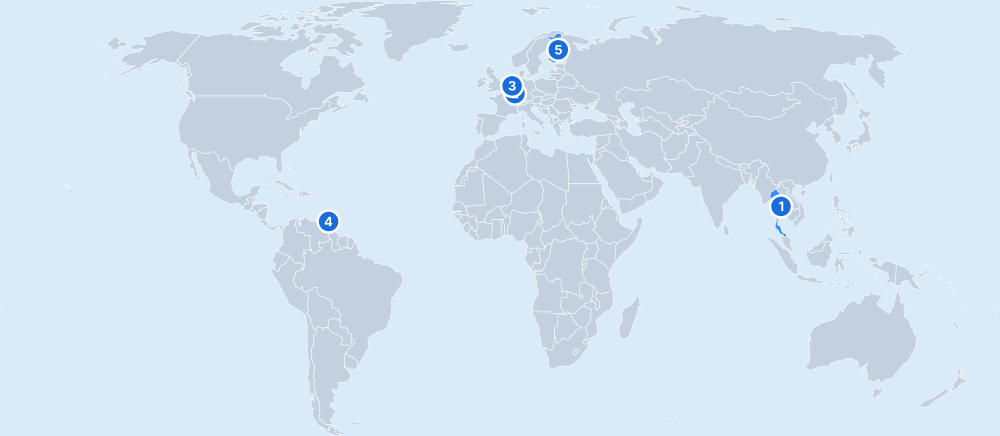
1. The ancient capital of Ayutthaya that ruled a powerful kingdom for four centuries is sacked and burned by invading armies.
Answer: 🇹🇭 Thailand · 1767
The city of Ayutthaya, capital of a Thai kingdom that had flourished for over four centuries, was sacked and burned by Burmese armies, its temples looted and its population scattered. Early European travellers had ranked Ayutthaya among the great powers of Asia alongside Ming China, a cosmopolitan river city grown rich on trade. Its destruction ended the kingdom but not the nation: within decades a new Siamese capital rose downriver at Bangkok. Ayutthaya’s brick ruins, now a UNESCO World Heritage Site, still testify to its lost splendor.
Geography clue given: It is the only Southeast Asian nation never colonized by a European power.
2. Five nations sign a border-free travel agreement aboard a vessel beside the village that gives it its name.
Answer: 🇱🇺 Luxembourg · June 14th, 1985
Aboard a boat on the Moselle river near the Luxembourg village of Schengen, five members of the European Economic Community signed an agreement to gradually abolish checks at their common borders. France, West Germany, Belgium, the Netherlands and Luxembourg envisioned vehicles crossing frontiers without stopping and harmonised visa policies; a 1990 convention completed the plan. The tiny riverside village gave its name to what became the Schengen Area, within which hundreds of millions of Europeans now travel without internal border controls, one of European integration’s most tangible achievements.
Geography clue given: This tiny landlocked country is one of the world's wealthiest per person.
3. A museum devoted to Van Gogh's work opens in the low-country capital of his birth nation.
Answer: 🇳🇱 Netherlands · June 2nd, 1973
The Van Gogh Museum opened in Amsterdam on 2 June 1973 to house the collection preserved by Vincent van Gogh’s family. Its original building was designed by Dutch architect Gerrit Rietveld, and a later exhibition wing was designed by Kisho Kurokawa. The museum holds the world’s largest collection of Van Gogh’s paintings and drawings, together with letters and works by contemporaries. Its displays trace his development from dark early scenes in the Netherlands to the vivid color and expressive brushwork of his years in France, making it a major center for research on the artist.
Geography clue given: About 26% of it lies below sea level, protected by dikes.
4. A protest movement triggers a state of emergency and an army mutiny.
Answer: 🇹🇹 Trinidad and Tobago · April 21st, 1970
The Black Power Revolution grew from demonstrations in Trinidad and Tobago during early 1970, as activists challenged racial inequality, foreign economic influence, and limited opportunities for the country’s Black majority. The government declared a state of emergency on April 21 and arrested movement leaders. Several army units then mutinied, deepening the crisis. The unrest helped push the government toward economic and social reforms.
Geography clue given: This twin-island nation is the southernmost in the Caribbean.
5. Gentle white trolls debut in a wartime picture book.
Answer: 🇫🇮 Finland · 1945
Finnish writer and illustrator Tove Jansson introduced the Moomins in a wartime picture book, conjuring a gentle valley of round, white, hippo-snouted trolls as an escape from the darkness of the war years. Writing in Swedish, Finland’s second language, Jansson went on to produce nine novels, five picture books and a long-running international comic strip about the Moomin family between 1945 and 1993. The philosophical, quietly melancholy stories became a cornerstone of Nordic childhood and a global phenomenon spanning television series, films, theme parks and ubiquitous mugs.
Geography clue given: It contains 187,888 lakes larger than 500 square metres.
More historical events
- A jazz-composing king begins a seven-decade reign.
- A Southeast Asian kingdom renames itself, choosing a name meaning 'land of the free'.
- The great High Dam is completed on the Nile.
- A 67-metre obelisk is raised in nine weeks in a capital on the River Plate.
- Mountain gorilla research begins at a volcanic highland research station.
- Privateers turn a coral archipelago into a pirate stronghold during the Golden Age of Piracy.