
Wherio #15 — July 27th, 2026
Five real historical events. Guess where each one happened, then compare your score with the answers and locations below.
Play Wherio #15
Try all five events before revealing the answers.
Reveal answers and mapHide answers and map
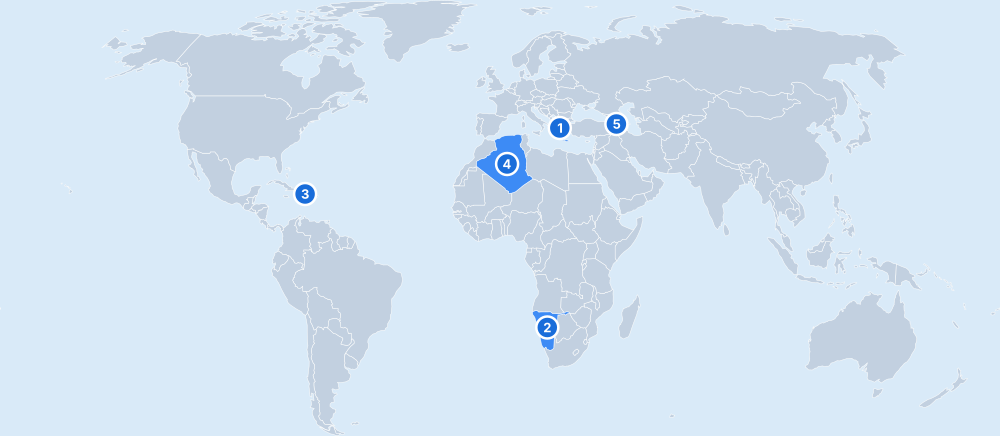
1. Divers recover the mysterious Antikythera mechanism from a shipwreck off the coast of an island with the same name.
Answer: 🇬🇷 Greece · 1901
Sponge divers salvaging a Roman-era shipwreck off the Greek island of Antikythera brought up corroded bronze fragments that proved to be the most astonishing artifact of the ancient world. The Antikythera mechanism, a hand-powered geared device built in the 2nd century BC, could predict astronomical positions and eclipses decades in advance and even track the four-year cycle of the ancient games. Recognized as the oldest known analogue computer, its sophistication went unmatched for well over a millennium, and researchers are still decoding its workings with modern imaging.
Geography clue given: The ancient Olympic Games began here in classical antiquity.
2. A former South African mandate on the Atlantic coast of southwestern Africa becomes independent after decades of liberation struggle.
Answer: 🇳🇦 Namibia · March 21st, 1990
Namibia became independent from South African administration on March 21, 1990. The transfer followed a United Nations supervised election and a transition process established through international agreements. Sam Nujoma was sworn in as the country’s first president at the independence ceremony. March 21 is recognized as a national public holiday under Namibia’s post-independence holiday system.
Geography clue given: Its namesake desert has some of the world's tallest sand dunes.
3. Rebels fire a signal shot at a fortress on the eastern side of Hispaniola and declare a new republic.
Answer: 🇩🇴 Dominican Rep. · February 27th, 1844
The Dominican Republic declared independence from Haiti on February 27, 1844, ending twenty-two years of rule from the western side of Hispaniola. Members of the secret society La Trinitaria organized the independence movement and launched the uprising. The new state adopted its first constitution later that year. Fighting to defend the republic continued after the initial declaration.
Geography clue given: It shares the island of Hispaniola with Haiti.
4. Authorities enter a university in the mountainous Kabylia region, intensifying protests for Berber language and cultural rights.
Answer: 🇩🇿 Algeria · April 20th, 1980
The Berber Spring developed from demonstrations in Algeria during April 1980, after authorities canceled a lecture by writer Mouloud Mammeri and suppressed protests in the Kabylia region. Police entered the University of Tizi Ouzou on April 20, intensifying the unrest. The movement demanded recognition of Amazigh language, culture, and identity. It became a defining event in modern Berber political activism.
Geography clue given: Most of its vast territory lies within the Sahara Desert.
5. A powerful earthquake ruptures faults in the northern Caucasus, devastating Spitak and nearby communities.
Answer: 🇦🇲 Armenia · December 7th, 1988
A surface-wave magnitude 6.8 earthquake struck northern Armenia, then a Soviet republic, with devastating intensity centered near the town of Spitak. Striking late on a winter morning while schools and factories were full, the quake and its immediate aftershock leveled poorly built apartment blocks and killed tens of thousands of people in seconds. The catastrophe prompted Moscow, in a Cold War first, to accept large-scale Western humanitarian aid, and reconstruction was still incomplete when the Soviet Union itself dissolved three years later.
Geography clue given: It was the first country to adopt Christianity as a state religion.
More historical events
- An Olympic flame relay tradition is invented.
- Reagan and Gorbachev hold a dramatic 1986 summit on a volcanic North Atlantic island.
- Heinrich Schliemann begins excavating the site of Troy.
- A gymnast scores the first perfect 10 in Olympic history.
- A new constitution replaces a charter that had lasted more than a century.
- A central African territory becomes an independent republic.