
Wherio #16 — July 28th, 2026
Five real historical events. Guess where each one happened, then compare your score with the answers and locations below.
Play Wherio #16
Try all five events before revealing the answers.
Reveal answers and mapHide answers and map
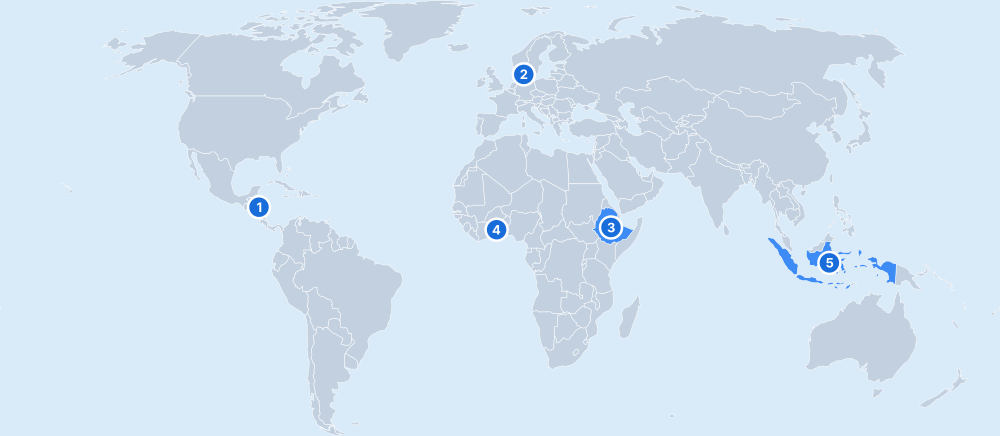
1. Soldiers seize the president at his residence and fly him across the southeastern border to Costa Rica.
Answer: 🇭🇳 Honduras · June 28th, 2009
On June 28, 2009, the Honduran military detained President Manuel Zelaya and removed him from the country. The action followed a political confrontation over Zelaya’s proposed public consultation and was carried out under orders connected to the country’s courts. Congress named its speaker, Roberto Micheletti, interim president. The removal triggered a constitutional crisis, international condemnation, and months of political unrest.
Geography clue given: Ancient Maya ruins at Copan lie within it.
2. An amusement park opens on the former fortified glacis just outside the west gate of a Nordic capital.
Answer: 🇩🇰 Denmark · August 15th, 1843
Tivoli Gardens opened in the heart of Copenhagen, a pleasure garden of rides, music and lamplit promenades that is now the second-oldest operating amusement park in the world. Founder Georg Carstensen reportedly won King Christian VIII’s blessing by arguing that when the people amuse themselves, they do not think about politics. The formula endured: Tivoli remains Scandinavia’s most visited amusement park, drawing over four million guests a year beside Copenhagen’s central station, and its fairy-tale atmosphere is often cited as an inspiration for Disneyland.
Geography clue given: It governs the world's largest island, Greenland, far across the ocean.
3. Rock-hewn churches rise at a pilgrimage center about 2,500 metres above sea level in the Lasta highlands.
Answer: 🇪🇹 Ethiopia · 12th-13th century
A remarkable group of rock-cut Christian churches was created at Lalibela in the Ethiopian highlands, mainly during the Zagwe dynasty and traditionally associated with King Gebre Meskel Lalibela. Rather than being assembled from blocks, many were carved downward and inward from solid volcanic rock, with trenches, passages and courtyards linking the complex. Eleven principal churches are commonly grouped on either side of a channel called the Jordan River. Their exact chronology is debated, but Lalibela became one of Ethiopia’s holiest pilgrimage centers and a symbolic new Jerusalem.
Geography clue given: It follows its own calendar with thirteen months.
4. Voters across a Gulf of Guinea nation approve a constitution establishing a Fourth Republic.
Answer: 🇬🇭 Ghana · April 28th, 1992
Ghanaians approved a new constitution in a national referendum on April 28, 1992. The charter established the legal framework for the Fourth Republic and prepared the country’s return to elected civilian government after years of military rule. It provided for a presidential system, a legislature, and constitutional protections for political participation. The document remains the foundation of Ghana’s current democratic order.
Geography clue given: Its flag added a black star as a symbol of African freedom.
5. A vast Hindu temple compound rises on southern Java near the boundary between two present-day provinces.
Answer: 🇮🇩 Indonesia · c. 850
The towering Hindu temple compound of Prambanan rose on the fertile plain of southern Java, near the volcano Merapi, dedicated to the Trimurti of Brahma the Creator, Vishnu the Preserver and Shiva the Destroyer. Its tallest spire, honoring Shiva, climbs 47 meters above intricately carved galleries depicting the Ramayana. The largest Hindu temple site in Indonesia and the second-largest in Southeast Asia after Angkor Wat, Prambanan is a UNESCO World Heritage Site whose pointed silhouette still defines the skyline between Yogyakarta and Central Java.
Geography clue given: It is the world's largest archipelagic state, spanning thousands of islands.
More historical events
- Divers recover the mysterious Antikythera mechanism from a shipwreck off the coast of an island with the same name.
- A former South African mandate on the Atlantic coast of southwestern Africa becomes independent after decades of liberation struggle.
- Rebels fire a signal shot at a fortress on the eastern side of Hispaniola and declare a new republic.
- Authorities enter a university in the mountainous Kabylia region, intensifying protests for Berber language and cultural rights.
- A powerful earthquake ruptures faults in the northern Caucasus, devastating Spitak and nearby communities.
- Reagan and Gorbachev hold a dramatic 1986 summit on a volcanic North Atlantic island.