Real photographs
WhenTaken, Chronophoto and EraPin stay closest to the TimeGuessr feel.

TimeGuessr asks two questions about every historical photo: where and when. These alternatives keep one or both, and swap the photo for museum artifacts, AI-built scenes, written clues or plain street views.
By Rachel Tublitz, creator of Wherio · Updated
Daily puzzle
In 1453, this city became the capital of the Ottoman Empire after a pivotal siege.
WhenTaken is the closest game to TimeGuessr: five photos a day, a map pin and a year for each. Chronophoto is the pick if you only want to guess the year. EraGuessr and HistoryGuesser go further back in time with AI-generated scenes, Anthropeum uses real museum artifacts, and Wherio replaces photos with written events and asks only for the country.
The biggest difference between these games is what you're looking at. Pick the clue you enjoy reading, and the rest follows.
WhenTaken, Chronophoto and EraPin stay closest to the TimeGuessr feel.
EraGuessr and HistoryGuesser reach periods before cameras existed.
Anthropeum asks where and when real artifacts were made.
Wherio and Terra Tempus describe the moment instead of showing it.
Pin where and when each photo was taken, from 1860 to today
Guess the year a photo was taken on a 1900 to 2025 slider
Explore an AI-generated historical panorama, then pin where and set when
Explore a 360-degree historical scene, mostly AI reconstructions, then pin where and when
Pin where a museum artifact was made and pick its period
Pin the place and set the year of a photo that comes with a cryptic clue
Read a written historical event, then tap the country where it happened
Read a clue about a real event, pin where it happened and place the year on a timeline
Drop a pin where a street-level photo was taken
Work out where you are from Street View imagery and drop a pin
| Game | What you do | Format | You answer with | Cost | Archive |
|---|---|---|---|---|---|
| WhenTaken | Pin where and when each photo was taken, from 1860 to today | Daily · 5 rounds | Map pin + year | Free with ads | Yes |
| Chronophoto | Guess the year a photo was taken on a 1900 to 2025 slider | Daily · 5 rounds + unlimited | Year | Free | No |
| EraGuessr | Explore an AI-generated historical panorama, then pin where and set when | Daily + unlimited modes | Map pin + year | Free; EraGuessr+ $19.99/yr | EraGuessr+ only |
| HistoryGuesser | Explore a 360-degree historical scene, mostly AI reconstructions, then pin where and when | Daily · 5 scenes | Map pin + year | Free with ads; Pro $39.99/yr | Yes |
| Anthropeum | Pin where a museum artifact was made and pick its period | Daily · 10 artifacts | Map pin + period | Free | No |
| EraPin | Pin the place and set the year of a photo that comes with a cryptic clue | Daily · 5 rounds | Map pin + year | Free | Yes |
| Wherio | Read a written historical event, then tap the country where it happened | Daily · 5 rounds | Country | Free; optional Pro | 2 free plays a day; unlimited with Pro |
| Terra Tempus | Read a clue about a real event, pin where it happened and place the year on a timeline | Daily + endless · Apple devices | Map pin + year | Free; Pro $29.99/yr | Past answers only, free |
| WhereTaken | Drop a pin where a street-level photo was taken | Daily · 5 rounds | Map pin | Free with ads | Yes, free |
| GeoGuessr | Work out where you are from Street View imagery and drop a pin | Free daily challenge + paid unlimited | Map pin | Free tier; paid unlimited | Your last 7 days |
There is no universal winner. Each pick below says who it suits and where another game on the list does the job better.
By Teuteuf Games, the studio behind Worldle
WhenTaken is TimeGuessr with a different photo library: five rounds a day, a pin on the map and a year from 1860 to today. It comes from Teuteuf Games, the Worldle studio, and has an archive and a community games section. If you finish TimeGuessr and want one more, start here.
Compared with Wherio: WhenTaken asks for a precise pin and a year. Wherio asks only for the country, so you can reason from the event rather than the scenery.
Visit WhenTaken (opens in a new tab)Chronophoto drops the map and asks only when each photo was taken, on a slider from 1900 to 2025. Clothing, cars, film grain and color become the evidence. It is a good warm-up for TimeGuessr's year slider, and party mode lets a group play the same five photos.
Visit Chronophoto (opens in a new tab)EraGuessr reaches back thousands of years by generating historical panoramas with AI, then asks where and when. That opens up periods photos never could. The trade-off is that the scenes are illustrations, not evidence, and the archive and filters sit behind EraGuessr+.
Visit EraGuessr (opens in a new tab)HistoryGuesser gives five daily scenes you can look around, mostly AI reconstructions from 3000 BC to today, and asks for a place and a year. It adds era runs, country packs and party play, and it keeps a free daily archive.
Visit HistoryGuesser (opens in a new tab)By Matthew Chu, using open-access museum collections
Anthropeum shows ten objects a day from open-access museum collections and asks where each was made and in what period. Pottery, textiles and tools test a different kind of knowledge than street photos. It is free, and Scientific American covered it in July 2026.
Visit Anthropeum (opens in a new tab)EraPin pairs each 20th-century photo with a cryptic written clue, then asks for a pin and a year. Hints cost points, past days are playable, and there is a classroom mode. It sits halfway between TimeGuessr's pure visual reading and a written history game.
Visit EraPin (opens in a new tab)
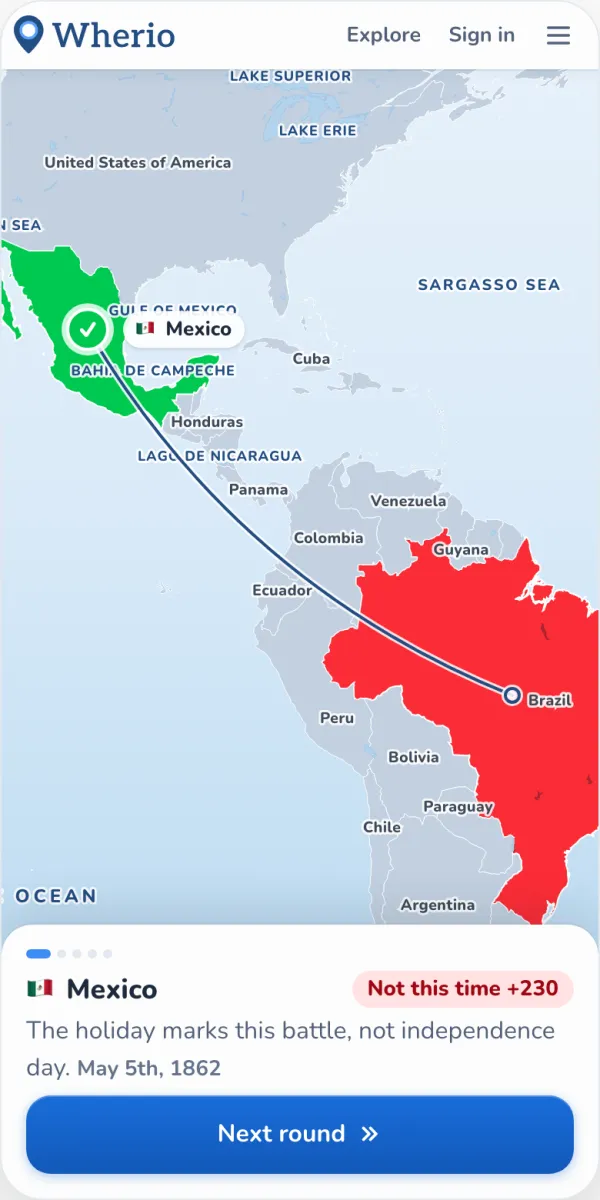
Wherio is our game. Instead of a photo, each round is a short written event, from ancient empires to the space age, and you tap the country where it happened. There is no year to guess, which keeps rounds quick, and the reveal explains what happened. It suits TimeGuessr fans who enjoy the 'where' half most.
Play Wherio freeBy Endpaper Labs
Terra Tempus is an Apple-only app that reads a clue about a real event and asks for both a pin and a year. A free daily challenge and endless play sit beside paid courses on the American Revolution. It is the closest written-clue match to the TimeGuessr two-part answer.
Visit Terra Tempus (opens in a new tab)By Teuteuf Games, the studio behind Worldle
WhereTaken is WhenTaken's sibling without the year. Five modern street-level photos a day and a free archive make it a lighter companion when you only want TimeGuessr's map half.
Visit WhereTaken (opens in a new tab)By GeoGuessr AB
GeoGuessr has no history, but it is where TimeGuessr players often go to sharpen the location half. Street View lets you move around for more clues. The daily challenge is free with an account; unlimited play is paid.
Visit GeoGuessr (opens in a new tab)Whether the clue is a photo, an object or a sentence, the same habits narrow the place and period quickly.
Vehicles, clothing, signage and photo quality usually narrow a photo to a few decades before you think about place.
Scripts, languages and brand names are the strongest location clues in any photo game, and the strongest in a written one too.
In Wherio's own data, rounds that name a famous person from a different country than the answer are solved about 11 percentage points less often. Ask where the event happened, not who it was about.
After each game, read the explanation for your biggest miss and connect it to something you already know.
Wherio keeps the daily history-and-place idea and swaps photographs for short written events. That lets each puzzle range from prehistory to the present, and the reveal explains what actually happened.
Daily puzzles from June 1 to October 11, 2026, from Wherio's own analytics.

Rachel Tublitz builds Wherio, so Wherio is on this list and marked as our game. Every other game was checked on its live site in October 2026 for format, cost, archive access and whether you need an account. The order reflects how well each game fits this particular search, not whether it competes with us.
Games change often. If something here is out of date, email hello@wherio.app and we will fix it.
WhenTaken is the closest alternative: five photos a day, each answered with a map pin and a year. Chronophoto is best if you only want to guess the year, and Wherio is best if you prefer written historical events to photos.
Yes. Wherio and Terra Tempus use written clues about real events. Anthropeum uses photos of museum objects rather than scenes, and EraGuessr and HistoryGuesser use generated panoramas.
Photo games start in the 1800s. EraGuessr, HistoryGuesser and Anthropeum go back thousands of years, and Wherio includes ancient and prehistoric events in its daily mix.
All of them have a free daily mode. TimeGuessr, WhenTaken, HistoryGuesser and WhereTaken show ads, with paid ad-free options. EraGuessr and Terra Tempus sell subscriptions for extra modes.
TimeGuessr shows a photo and asks for a precise location and year. Wherio describes a historical event in words and asks which country it happened in, then explains the answer.
Read the event, find the country, and see what happened there.
Play Wherio free